
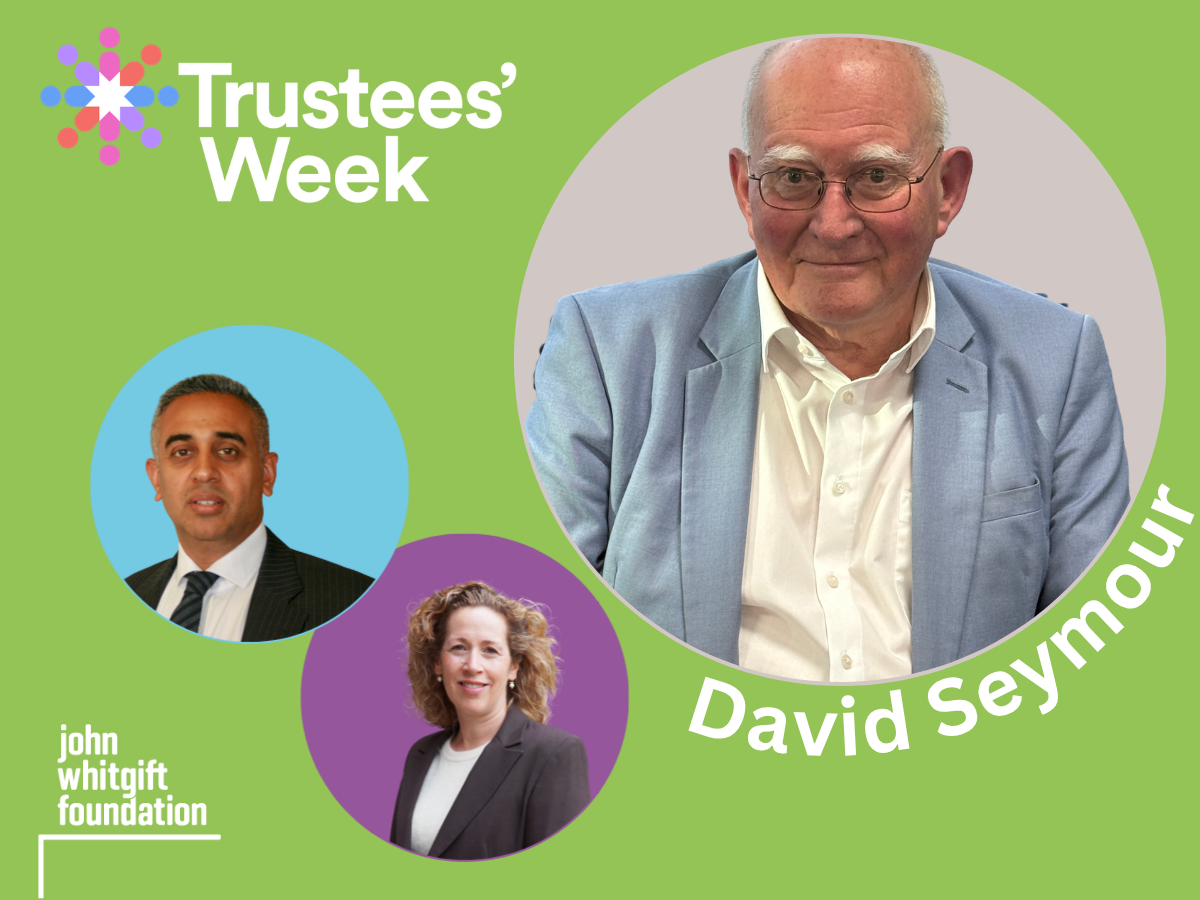
To mark Trustees’ Week, we’re celebrating the Court governors who give their time to guide the John Whitgift Foundation. David Seymour, Chair of Governors at Trinity School, is in his final year of service after more than a decade on the Court.
An unexpected invitation
David is in his twelfth, and sadly final, year as a Court governor. As Chair of Governors at Trinity School, he sits on the Court and also serves on the Remuneration Committee and the Education Committee.
This wasn’t a role David had gone looking for. He retired in 2012 and was already a governor at Trinity when the then chair stood down. “After a competitive process, I was asked to take over as chair of the school committee and as a Court governor,” he says. “As I was an old boy of the school, and I had time on my hands, I was happy to take it on.”
The importance of being present
David is modest about what he brings to the role, saying it’s “for others to say”. But he points to his commitment to the school and his background as a lawyer. “A centre of academic excellence for students and young people of all backgrounds is something I believe in quite passionately,” he says.
He sees the governor’s role as supportive. “The main job is not to run the school. My job is to make sure that it is run properly by the headmaster. It’s basically a supervisory role, and you’re there to encourage and be a constructive friend.”
For David, that means being present and engaged. “Whenever I go to the school to watch a play, or a concert, or a sporting event, it means a lot to the teachers and the students that somebody in my position takes an active interest in what they’re doing, and that you’re not some remote character.”
It also comes with a familiar problem. “Lots of people say, ‘Hello, David’ to me as I walk round the corridors. I don’t always remember their names, but I’m pleased that so many people at Trinity know exactly who I am, and that I have the best interests of the school at heart. I think you show your commitment by being present.”
David is equally clear about what that presence says to staff. “I do know how committed and how hard the teachers work. It’s important for me to show that recognition.”
A school going from strength to strength
Asked about his proudest moments, David points first to Trinity School. “I’ve just seen the school, under two headmasters, go from strength to strength, both academically and in the co-curricular sphere,” he says. “High performances in music, drama, sport, and academics.”
As a rugby fan, one moment stands out. “The highlight for me was to see the school 1st XV win the national rugby competition at Twickenham in the under-18 category.” He and his wife also enjoy the school concerts. “The music is of very high quality, as is the drama, which is varied and challenging.”
Being a Court governor is a different challenge. “With the school you’re focusing on school activities and finances,” he explains. “With the Foundation, it’s a much bigger organisation. There are two independent schools, there are care homes, there’s property, there’s the management of the endowment, and there are employment issues. There are much more wide-ranging issues that have to be dealt with as a Court governor.”
A purpose in retirement
For David, volunteering has also answered a question many people face. “Retirement is the one stage in your life for which you get no preparation,” he says. “You’re prepared for school as a toddler, for university, for your job. But retirement comes upon you, and you’re not trained to cope with it. It’s very important not to just stop, but to continue doing something.”
The role has been demanding, but he has valued the change of scene. “I worked as a lawyer, and suddenly you’re operating in an educational institution. It’s a completely different environment. In 12 years, I’ve learned a lot about how schools work, and with the Foundation I’ve learnt a lot about how a charity operates. That wouldn’t have happened had I not taken on this role.
“I’m very happy to have done it, and I’ve found it one of the most rewarding things I have done.”
We thank you for your trusted support and guidance, David.