
Harold has spent almost his whole life around flowers, from a wartime glasshouse in Folkestone to decorating Croydon Town Hall for the mayor. Now a resident of Whitgift House and celebrating his 100th birthday, he shares some of his favourite memories from a life well lived.
A Man of Kent
Harold was born in Folkestone in October 1926, in his grandmother’s flat above the family shoe shop. His earliest memories are of mischief. “There was a little girl about my age who had a habit of poking her head through a hole in the fence between our houses,” he recalls. “I got hold of a pair of scissors one day, and once she put her head through, I cut a lump of her hair. To this day I often see myself doing that.”
School was a little less memorable. A Christmas play stands out, mostly for the sailor suit a teacher seemed keen to dress Harold in. He explains: “She wanted to take my trousers off and put me in this sailor suit, in the classroom with everyone else around. I screamed and shouted, but eventually she won the day. I don’t remember anything about the play, but I remember getting ready for it.”
Harold worked hard at school but didn’t particularly enjoy it. Only during the 11-plus test was his short-sightedness discovered. “I had great difficulty seeing the blackboard, and I’ve worn glasses ever since.” He later wondered whether he would have passed the exam if he could have seen the questions properly. “But that’s life,” he says, shrugging.
Like many children of his era, Harold left school at just 13, having been evacuated to Wales with the other schoolboys.
A boy in the glasshouses
Harold’s lifelong love of gardening started early, in his grandparents’ garden. “They always let me have a little garden of my own. I can remember growing sweet peas.” On one occasion, trying to climb the railings at the back to pick poppies from the field beyond, he got hooked up by his trousers and had to be rescued. “I was never allowed to forget that.”
At 14, Harold started work in Folkestone’s parks department. “All the men in the glasshouses were called up, and they were looking for boys.” His father, driving an ambulance for the Air Raid Precautions service at the time, spotted the opening. Harold went to meet the park superintendent “all trembling, nervous”, and was taken on.
There was no formal apprenticeship, but the boys were treated as apprentices, and their foreman, Mr Gilbert, taught them hands-on. “Of course, during the war, we were growing vegetables all the time. Even in the cemeteries, on land that wasn’t yet taken over, we were growing potatoes and all sorts of vegetables.”
Geraniums for the mayor
Harold met his future wife, Lillian, at Sunday school. His father had one rule. “He said, ‘No, you’re not getting married before you’re 20.’ I was 20 in October, and we were married a few days later.”
A series of moves around Kent followed, from nursery to nursery, each with a house for Harold and Lillian’s growing family. One winter was particularly hard. “We were up all night stoking the boilers with coke,” Harold remembers. “That was a terrible winter, but we got through it.”
Harold joined Croydon Council after spotting a job for a floral decorator. His job involved dressing civic occasions with flowers. “Wherever the mayor went to a function that was backed by the council, we had to go and put flowers. For mayor-making day we used to decorate the whole of the town hall inside, and Fairfield Hall too.” For one dinner, the team built a garden in the middle of the table, complete with a pond and a little fountain.
Looked after
After heart attacks in his fifties, the council moved Harold, Lillian, their two daughters and their dog into a bungalow. He returned to work and rose through the ranks, becoming area supervisor, then south area manager, then assistant chief officer. His retirement came suddenly.
The council’s doctor told him he should have retired five years earlier. “I asked if I could stay till Easter, so I could leave everything ready for somebody else. He said, ‘My lad, when I’ve signed a letter which says that you will retire, you are no longer employed by the council.’”
Retirement didn’t mean slowing down though. Harold served as secretary of two local horticultural societies and enjoyed working on his allotment.
Life at Whitgift House
In 2003, after losing his dear wife Lillian, Harold moved into Whitgift House, where he has lived ever since. She would have turned 100 this month, too. Harold marked the occasion the best way he knew how. “I did a big display of roses in the chapel on Wednesday.”
Since he moved into Whitgift House, Harold’s family has grown. He is a proud grandfather four times over and a great-grandfather to eight children, the youngest of whom is almost a year old.
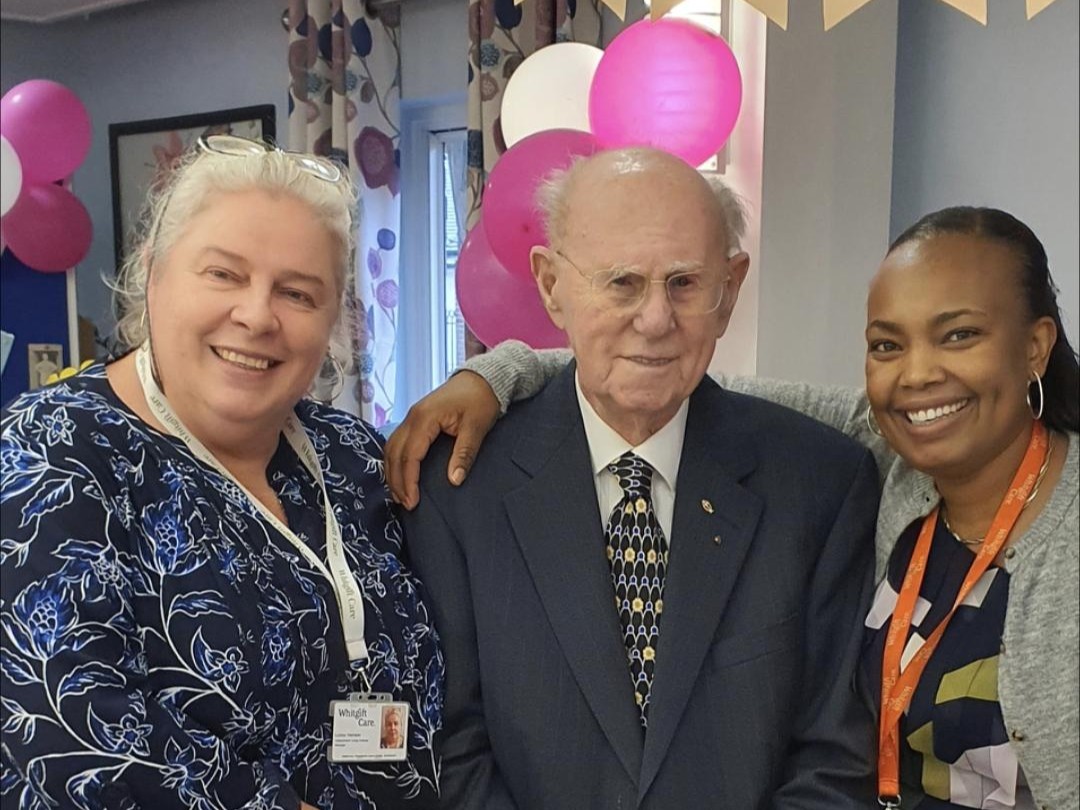
Harold is a much-loved member of the Whitgift Care community, and we are pleased to celebrate his centenary with him. Family, friends and neighbours joined a party held in his honour at the weekend.

Harold addresses a room full of his loved ones and friends at his 100th birthday party

Harold’s beautiful birthday cake offered a nod to his horticultural career