

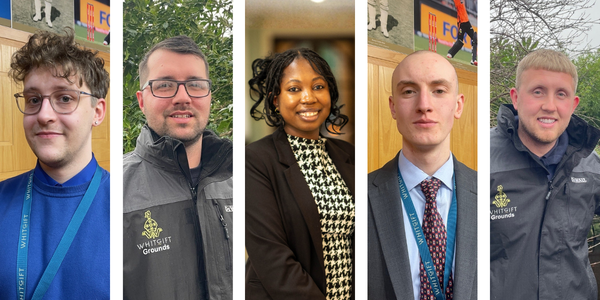
Apprenticeships are transforming the way people start and build their careers. During National Apprenticeships Week, we’re celebrating the real-life experiences of five of our current and former apprentices who have built successful careers in a range of roles.
Apprenticeships offer opportunities to develop industry-specific skills in a busy work environment while receiving structured training and support. Rather than choosing between education and employment, apprentices benefit from both, gaining recognised qualifications alongside meaningful work experience.
Our colleagues’ stories show how apprenticeships can open doors, build confidence, and create long-term career opportunities.
Alternative to university
Panashe Mbanje (pictured centre) works in data analysis in the Alumni and Development Team at Trinity School. She initially joined the team through an apprenticeship scheme, which she felt would be a better option than studying at university.
“I spent a year in an entry-level data role and wanted to progress into data analysis without going to university. University is expensive, and you still need work experience when you finish, so I felt the best approach was to apply for an apprenticeship. Nothing beats getting hands-on experience while being paid to do the job.”
Kevin McCreadie (pictured far left), a desktop engineer in the IT Team at Whitgift School, agrees with Panashe. He explained: “I went to uni and tried to get a job, then Covid happened. I wasn’t employed, and everyone was saying, “You don’t have the experience”. An apprenticeship was the next option for me, so that I could get experience and a job.”
Kevin’s colleague and fellow former IT apprentice, Jacob Boulter-Howard (second from right), added: “You learn the theory and the technical language, but that didn’t compare to what you learned on the job. Having the course day was great, but actually coming in and learning was the most helpful thing.”
“I finished my apprenticeship in June of last year, so I’m not studying currently, but I’m still learning, just not in an official way.”
Flexible learning
As members of the Grounds Team at Whitgift School, Matt Harris (second left) and Jay Campbell-Waggott (pictured right) set up, maintain, and prepare all the school’s sports pitches. Additionally, Jay is responsible for the irrigation system. Matt’s apprenticeship involved attending college each week, while Jay’s learning has mostly taken place online, as with Panashe, Kevin, and Jacob.
This reflects a significant change from the apprenticeships of old. The model has undergone a digital transformation in recent years and now offers a more flexible approach to learning. Panashe found this suited her, but Jay felt it might not be right for everyone.
Panashe said: “I had two workshop days each month, which were compulsory and held online. We would cover a specific topic, learn the basics, and discuss them with the tutor. They would then encourage you to apply this to your everyday role, which made the learning practical and engaging.”
“With online learning, there isn’t someone pushing you constantly,” Jay explained. “If you’re going into college, then you’ve got a teacher who is asking whether you have done this or caught up on that. When you’re learning remotely, you can send an email, and it may take 3 or 4 days to hear back.
“You’ve got to be motivated to motivate yourself.”
Career progression
One benefit of apprenticeships that all five of our colleagues highlighted was the opportunity for career progression. Kevin is considering specialising in a specific area of computing, such as security or networking. Jay’s long-term goal is to pursue a managerial role or run his own business, while Matt is working toward completing his Level 3 apprenticeship.
Matt said: “I think apprenticeships open up better-paid jobs within the industry; you can go somewhere, whereas if you don’t have those qualifications, you’re going in on an entry-level path.
“My mate got me into the industry when he needed an extra pair of hands at work, and it seemed like fun. After that, I got a job at a golf course, and it just stemmed from there. I completed my Level 2 and hope to finish my Level 3 in the next couple of years.
“Ultimately, I came here as an apprentice and last week I was offered a permanent contract.”
Benefits for employers
Tory Stubbs, Head of People and Care at John Whitgift Foundation, said: “Apprenticeships mean that new and existing employees receive structured training and develop skills that benefit them personally and support what we’re trying to achieve as an organisation.
“In our experience, apprentices bring fresh ideas, enthusiasm, and a willingness to learn.”