
To mark Local and Community History Month, we welcomed two groups of local people behind the gates of the Whitgift Almshouses for a guided tour. If you haven’t yet had the chance to visit, or if you want to know more about the historic building at the corner of North End and George Street, here are some of the tour highlights and stories we shared.
Background
Archbishop John Whitgift built the Hospital of The Holy Trinity (now known as the Whitgift Almshouses) in 1596.
Noting the hardships endured by the people of Croydon and Lambeth (including his own workers), Archbishop Whitgift developed his vision to leave a legacy to the town. He wanted to build an Almshouse to look after the poor and needy and a school to educate the young. He purchased land and wrote to Queen Elizabeth I to ask permission to build a hospital on the site. The licence was granted, and the first two foundation stones were laid for the Hospital of the Holy Trinity on 22nd March 1596.
Our modern understanding of a hospital is that of a medical setting, but the term has evolved across the centuries. Back in the 10th and 11th centuries, hospitals were places where the poor, sick and injured could receive care. The term would pay homage to the origins of ‘hospitality’ – or a place offering refuge and welcome for the traveller, needy, and so on.
By the 16th and 17th centuries, the term hospital came to describe lodgings for the poor, for local people who were part of a particular community (such as working for a religious institution or person), or for those living in a specific area.
The historic building
Designed as a quadrangle, the Almshouses were built around a private courtyard. The style is reminiscent of the ‘quads’ at an Oxford or Cambridge college.
Several of the building’s features have changed over the years. The Chapel entrance has been altered, as have the chimneys, windows and doors. The roof was almost completely retiled after World War Two. In some ways, it’s remarkable that the historic building is still standing.
Significant development work has taken place on all four sides of the site, but one of the most significant threats to its future came in 1923, when the Almshouses were threatened with demolition as part of various reconstruction plans and road-widening schemes.
The House of Lords intervened, and the Almshouses are still standing strong. Today, the site provides sheltered independent living for older members of our community.
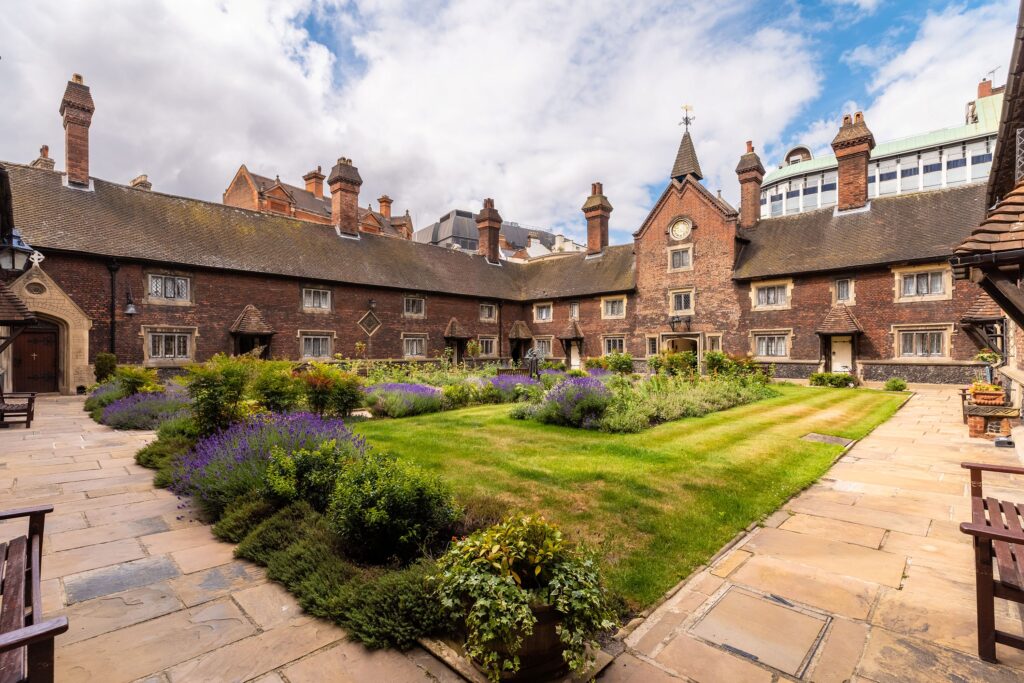
The central courtyard of the Whitgift Almshouses
Inside the Almshouses
The Audience Chamber was used as a meeting room by Archbishop John Whitgift, and it is still used for that purpose today. The oak-panelled room features an original fireplace and an ‘Armada’ chest which would have provided safe storage for important documents, coinage, and possibly even weapons.
On the walls hang an original Letters Patent issued by Queen Elizabeth I and Whitgift’s Deed of Covenant. Seemingly at odds with these official documents is an original sign from The Swan public house. The connection being that Archbishop Whitgift purchased the pub (along with four acres of land) to form part of the endowment for the hospital and the school he founded.
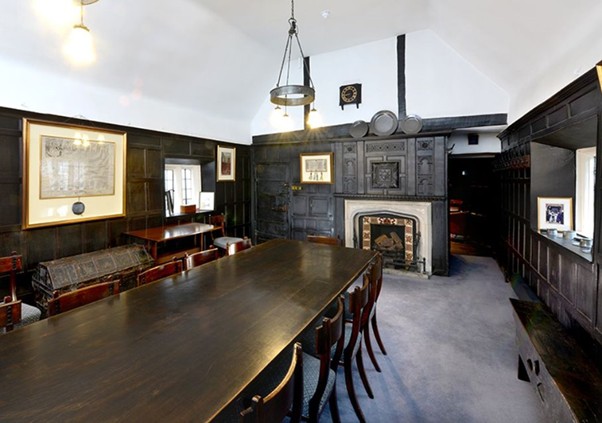
The dark wood panelled interior of the Audience Chamber
Beneath the Audience Chamber is the Common Room. This room also has an original fireplace, but this one features Archbishop Whitgift’s initials in Latin (IW rather than the more familiar JW). An original section of John Whitgift’s tomb is on display, having been damaged in a fire at Croydon Minster in 1867. The tomb was restored and can be seen in the Minster today.
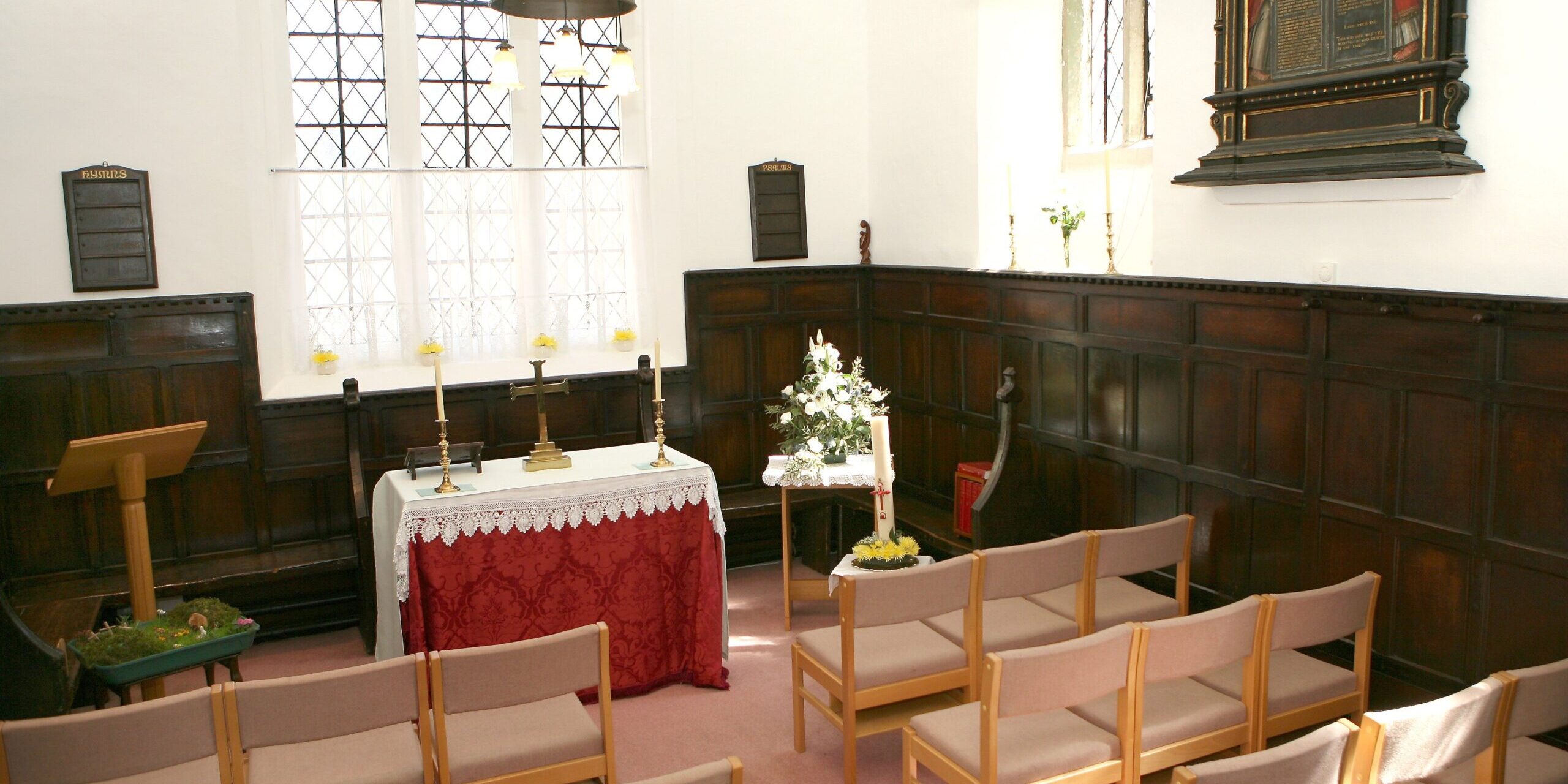
The Chapel, with panelling dating from 1640, is still in use. The lettering over the door reads ‘My house shall be called ye house of prayer’. More comfortable modern chairs may have been installed, but the original chestnut pews remain around the edges of the room.
A feature of the Almshouses that always attracts comments from visitors is the one-handed clock. Located above the North End entrance, facing the quadrangle, the clock dates back to a time when minutes could not be counted accurately. Despite the absent minute hand, the clock still shows a good approximation of the time.
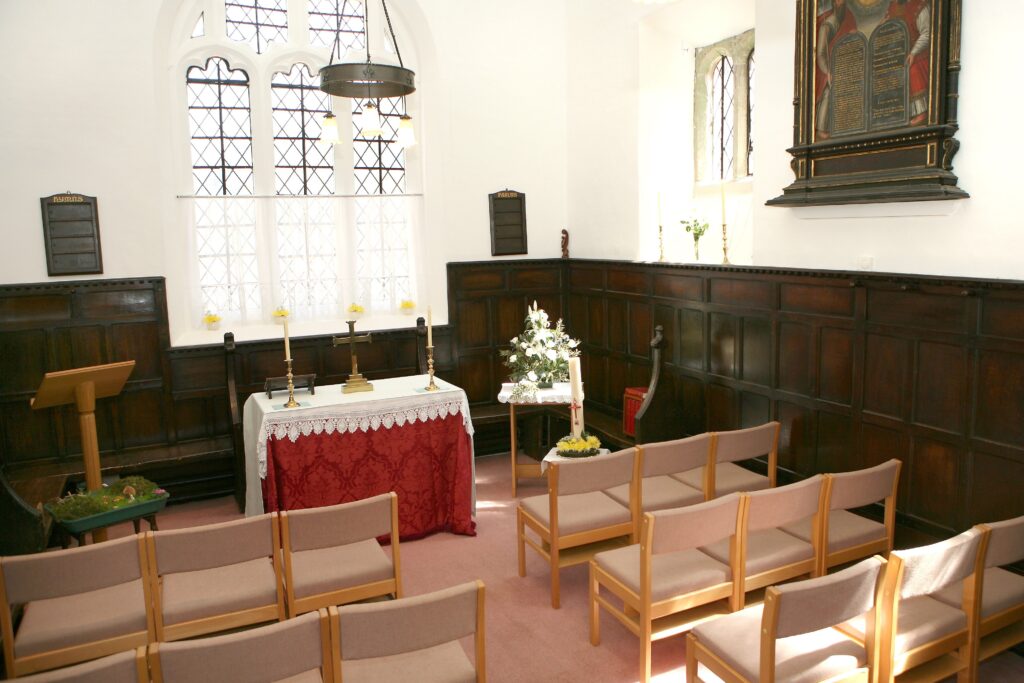
Inside the Chapel at Whitgift Almshouses
Life in the Almshouses
Few rules govern the Almshouses today, and daily life is very relaxed, but it wasn’t always that way. John Whitgift’s Statutes (akin to guiding principles) set out a list of ‘crimes that must be avoided’ in the 1600s.
Residents of the hospital would be admonished, fined or even expelled for offences such as “forgery, perjury, Sorcery or any kind of Charminge or Witchcraft”. Being a “swearer, a gamester, a brauler or fighter” was forbidden, and residents were not allowed to be “a Haunter of Taverns or alehouses.”
Historic records suggest the Hospital operated on a ‘three-strikes-and-you’re-out’ policy, with repeat offenders expelled and permanently losing their place.
And finally…
Legend has it that the Almhouses have three ghosts: a guard who broke his neck falling down the stairs, an assassin who fell down the chimney, and a grey lady who smokes a pipe walking the corridors at night whilst rattling the door handles. Have you heard any of these tales?
If you missed out on our tours to mark Local and Community History Month, there will be more opportunities in September during Open House Festival.
This post was compiled with the kind assistance of Whitgift archivist, David Clifford and Bill Wood, former archivist and volunteer.